Monday, December 12, 2016

Third Tuesday in Advent


Zephaniah 3:1-2, 9-13; Psalm 34:1-8; Matthew 21:28-32
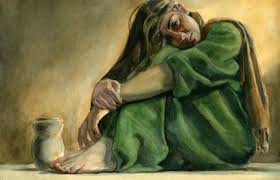

Please, God, save me from forgetting.  I spent so many years so far from you, among the tax collectors and prostitutes - really among them, belonging with them.  Gradually I approached you, gingerly and hesitantly; or, rather, you approached me and I stopped running.  And it was hard to turn to you.  My friends didn’t understand; they didn’t seem to miss you or need you.  The people who were there when I got near you weren’t sure what to do with me either: I didn’t dress right or think like them.   To them I was still a tax collector or a prostitute.  But I knew I was a former one; shaped by my experience, but not defined only by that.  And over time I saw that my former life was a gift, bringing compassion and patience for those who were still “out there.”

But God, it could be so easy to become one of the “haughty ones.”  I could forget that you drew me, and take credit for where I am and what I have today.  Please, save me from forgetting.  Save me from pride, from exulting in my own achievements.  Whatever you have to do to get my attention, please do it.  You’ve shown me my weakness many times, in ways I would not choose, and it’s always led me more deeply toward you.  Please, save me from forgetting.
Might this be your psalm too?

I will bless you at all times; your praise shall continually be in my mouth.
My soul boasts only in you; let the other outcasts hear and be glad.
Magnify God with me!  Let’s worship together!
I sought you, and you answered me, and delivered me from all my fears.
When I look to you I am radiant, and never ashamed.
My poor soul cried, and was heard by the LORD, and was saved from trouble.
Your angel encamps around those who fear you, and delivers them.  I’m proof.
Taste and see that God is good!  Happy are those who take refuge in you.


Please, please, please, help me to say yes and mean it!

Sunday, December 11, 2016

Third Monday in Advent


Numbers 24:2-7,15-17a; Psalm 25:3-8 (4-9 in NRSV); Matthew 21:23-27

"By what authority do you do these things?"  This is one of those questions that tells us more about the questioner than the respondent.  It's a question we've been asked a lot as Companions.

From the beginning of our journey people asked us three things about our community: "What's your Rule?" "What's your habit?" And, "What do you have to do to establish a community?"  By that third question they meant, whose permission do you need?  Whose acknowledgment?

We answered, "We don't know about our Rule yet." (We have since written one, after reading many old and new.)  "We don't know about a habit yet." (Now we wear black on Sundays and feast days, with shawls in chapel.  We don't know how long we will do this.) 
But the last question was easy to answer.  We said, "Move in together and start praying."
But of course that wasn't what our questioners were asking.  They wondered about authority, as though being a community required the blessing of a hierarchical gatekeeper.  As though without credentials we don't exist.

After two and a half years, two of us made life vows in this community that is recognized by no authority other than God and those around us.  Our vows are not legally binding or enforceable in court.  They are vows.  They are covenant.  We made these vows in the presence of others who acknowledge them by their participation.  There is nothing to keep us faithful other than our word and our trust in one another and in God.

In their recent book, An Other Kingdom, Peter Block, Walter Brueggemann, and John McKnight explore the power of vows and covenant as a way to turn from the consumer culture and legal empire and return to community.  Community is built on trust rather than threat.  

"By whose authority?" is a question for the legal culture, the alienated culture, to debate.  It's usually a trap, aimed to rein in something or someone.  It is not an empowering question.

It's a question Jesus refuses to answer.  He knows a trap when he sees it.  

I don't mean that there's never a place for authority.  But authority questions are not creative, or meant to be.  Knowing when that question matters and when it doesn't is a part of discernment, calling for prayer.

Is there someplace where you are trapped by the need for authorization?  Are you feeling called to do something or be something, and needing community acknowledgment?  If so, let me suggest a clearness committee or its equivalent, a circle of friends.  They won't authorize, they will companion you.  That's the creative community we all need.

Go!  And tell us what you find!


Saturday, December 10, 2016

Third Sunday in Advent


Isaiah 35:1-10; Psalm 146:4-9 (5-10 in NRSV); James 5:7-10; Matthew 11:2-11

We are halfway through Advent.  Or I should say, Advent season is half over, wherever you are in your Advent journey.  Some of us may not have started.  Others may be running toward Christmas, listening to Christmas music and shopping and baking and partying.  In the secular world, this is the season of Christmas.  It ends on December 26 with the sales, or maybe on New Year's Day.  But here, in our homes and churches, we await the Coming One.

Sitting in prison, John asks of Jesus, are you the one who is to come, or are we to wait for another?  Jesus invites John's disciples to look around and make their own determination.  He invites us to do the same.  All week we've been in this conversation about what we see and why we see it (or don't).  What we see, and hear, says as much about us as it does about the world around us.

John receives these reports in his prison.  His own small world is painful and ugly, but he hears of wonders beyond his world.  We don't hear what he decides about Jesus.  That's a blessing, I think: rather than being a story about John, this is a chance for us to ask ourselves what we decide.  Sitting in my own darkness, hearing reports of hope and healing, where do I put my trust?  

In fact, my situation is quite the opposite of John's.  My small world is filled with abundance and love.  I am supported beyond my wildest dreams.  But just beyond my door there are people who are hungry, people who are living on the streets, people who are violated and exploited.  Sitting in my small pool of light, where do I put my trust?  I oscillate between self-sufficiency and despair.  Both poles reveal my lack of trust in God.  

Times of endurance and patience call us back to God, to that decision point.  Where do I put my trust?  In what, in whom, will I believe?  Changes in the United States make this question particularly pressing.  Now I oscillate between terror and a certain expectancy, as I wait to see what I will become, who I will choose to be, whether I will be a faithful witness to the light.  Being a witness means honing my patience and my endurance.  Patience teaches me things that cannot be learned by easy success.  Endurance brings hope, and finally leads to joy beyond any particular delight.  This is not a situation I would have chosen, but few of my times of spiritual growth have been chosen.  That's not how it happens.  It happens by letting go into what we are confronted with, reaching out for God in the darkness.  

We're halfway through Advent.  Where are you?  


Friday, December 9, 2016

Second Saturday in Advent


Sirach (Ecclesiasticus) 48:1-11 (in the Apocrypha); Psalm 80:1-3,14-18; Matthew 17:9-13


“Elijah is indeed coming and will restore all things” (Mt 17:11).  Yet if John is the new Elijah, and he has been killed, where is this restoration?  The world continues on its sinful blind course.  This is one of the paradoxes of the “second coming,” and of the “kingdom of God.”  Jesus says, “The kingdom is here.”  Christians cry, “Christ is risen, and has trampled down death!”  Yet death in all its forms continues to appear, and from a certain view to dominate.  When we celebrate and proclaim the victory of God, we are looking from a different perspective than that of “the world.”  In the kingdom, restoration has happened, is happening, and will happen.

What, then, is restoration?  I’m mindful of the concept of restorative justice, which has become an important part of legal thinking over the last three decades.  For advocates of restorative justice, crimes are seen as a tear in the social fabric.  The offender cuts him/herself off from others, and often cuts off others from one another through death or separation or simple mistrust.  In these cases justice is found not in punishment, in “getting even,” or in “rehabilitation” of an individual offender to make them “useful” to society, but in the restoration of relationships.  Justice may involve direct apology, listening to the victims describe the impact of the crime on their lives, and making concrete reparations or amends as far as possible.  The goal is to heal the wound for both offender and victim so that they can get on with their lives.  It sounds a lot like confession and repentance and conversion to me.

Jesus, like John and Elijah and all the prophets, announces that the fabric of the covenant has been torn.  Many of those prophets died because their message was too challenging for the powerful.  But their insight continues to live and move us.  Repentance is returning to relationship, whether with other people or with God or with all of creation.  Restoration of relationship leads us to renew our vision and our commitment to our common life, and heals breaches of trust.  Jesus announces forgiveness of sins precisely as the key to renewed common life.

Is there someone in your life that you have cut off?  Is there a tear in your fabric that makes it hard to hold onto the message of new life?  Check in with your senses, internal and external, to see.  Where can you be part of the restoration of all things today?  And are you willing to pay the price?


Thursday, December 8, 2016

Second Friday in Advent


Isaiah 48:17-19; Psalm 1; Matthew 11:16-19

“Wisdom is vindicated by her deeds.”  Intriguingly, the NRSV translation says that some ancient authorities read “children” rather than “deeds.”  What’s at stake in that shift?  Jesus was seen by the earliest disciples as the embodiment of Wisdom, the one who "was with God at the beginning" of creation; hence the opening of John's Gospel, and the first O Antiphon, "O Wisdom."  The earliest version of this story said "children," but that implied that Jesus is the child of Wisdom rather than Wisdom herself.  So it became "deeds" pretty quickly.

Isaiah calls the people to wisdom: "O that you had paid attention to my commandments!  Then your prosperity would have been like a river, and your success like the waves of the sea" (Isaiah 48:18).  Jesus comes like Wisdom, who invites people to her banquet (Prov. 9:1-6).  Living with wisdom is a delight, not the hard road at all.  But seeing that takes some discernment.  This is what Jesus' audience lacks.  

Why do they fail to see what Jesus brings, what he is?  Why could they not hear John's call to prepare?  Why is it so hard to hear and see now?  This morning I had a new insight into the structure of denial.

It's easy to think of reasons why we might resist the call of wisdom.  It usually calls us to change our ways, our ideas, our relationships.  It's easier to deny climate change than to reinvent our energy needs and resources (though once again, the easier softer way turns out to be the more painful route).  Or we might go into denial because the one bringing wisdom doesn't look like what we expect: Who expected a Messiah from Nazareth, an itinerant preacher who eats and drinks with anyone who invites him?  But I think there's a deeper reason for denial.

When we are hurt we develop defenses.  Those defenses usually involve freezing some part of our emotions in order to survive.  We deny pain or fear or grief so we can "get on with our lives."  But freezing is not selective.  When we freeze some emotions, we blunt the whole apparatus.  The part that recognizes danger is needed, but if we have shut it down we can't see when we are in real trouble.  The part that senses danger is linked to the part that senses opportunity, so we miss that too.  So we ignore John's warnings, and we despise Jesus' invitations.  We don't do this intellectually; our intellect follows what we can see and feel.  

Advent is a time to renew our senses.  That is a painful and risky enterprise, and for some people it will require a trained companion.  But it's worth it.  Jesus comes with amazing news, good news, and you deserve to hear it.


If you sense that you've been missing something, that some level of love and wonder eludes you, now is the time to go searching for it.  Practice noticing the world around you, and within you.  Ask God to show you what you are missing, and to lead you to companions who will help you access it.  Go to Eucharist and make this request.  You are eating and drinking at Wisdom's feast - let her feed you richly!

Wednesday, December 7, 2016

Second Thursday in Advent


Isaiah 41:13-20; Psalm 145:1-4,8-13; Matthew 11:7-15


“What did you go out to see?” (Mt 11:9)  This is a good question for each of us.  What do you to church for?  Some people, honestly, go for the show.  They don’t name it that, but when asked they say they go for the choir or the music, or the beauty of the surroundings.  They go for the “soft robes” of the clergy and the choir, in the “royal palace” of a beautiful church.  
Other people go for the “liturgy.”  This can mean the same thing as the show, but sometimes it means being fed at Eucharist.  This may include hearing the word spoken and preached, but only if it leaves them feeling good.  These people want to be comforted (though not, perhaps, as God asks Isaiah to “comfort” the people, encouraging them to get on the road).  
Now, there’s nothing wrong with either response.  Nothing wrong; but something missing.  Just as John comes preaching repentance, and his crowds miss the boat if they only come for the show, so we too can miss the chance of a lifetime if we turn away from the hard words.  Even as Jesus names his yoke as easy and his burden as light, he pushes us toward the hard work of repentance and renewal.  If all we seek is comfort, we miss the real gift.  We get what Dietrich Bonhoeffer called “cheap grace.”  That grace is cheap both because it doesn't cost us much, and because it’s not worth much.  It’s settling for superficial relationship with God and with the deepest parts of ourselves.  It’s settling for nice music when transformation is on offer.
So: Why do you come to this page?  What do you hope for?

John is “Elijah who is to come.”  He is a prophet, the forerunner of the Messiah.  He carries an urgent message, a message that got him killed.  This message is no less scandalous and unwelcome today than when he preached it.  “Repent, for the kingdom of heaven has come near” (Mt 3:2).  When people came for baptism whom he suspected of coming for the show, he did not say, “Well, whatever you brought you here, we’re just so darn glad you’re here; we won't ask anything of you, no inconvenience or challenge, just welcome.”  No, he said: “You brood of vipers!  Who warned you to flee from the wrath to come?” (Mt 3:7)  He loved them enough to name their sickness and challenge them to true repentance.


I pray that I, that you, may find the desire for healing so strong that we hear the challenge as love and repent this Advent.  May we be found ready for the coming of the One who was, and is, and is always.  Amen.

Tuesday, December 6, 2016

Second Wednesday in Advent


Isaiah 40:25-31; Psalm 103:1-10; Matthew 11:28-30

“Take my yoke upon you . . . for my yoke is easy, and my burden is light.”
“[God] gives power to the faint, and strengthens the powerless.”

Here are two challenging promises.   We might want to hear words of comfort, such as yesterday’s passage from Isaiah or today’s Gospel, and they are part of the promise.  We might want God to come and find us when we’re lost.  But this isn’t a simple offer from God.  It’s not a promise that God will do all the work.  It’s a promise that God will strengthen us to do what needs to be done, if we cooperate.  Cooperating means “waiting for the LORD”: listening in prayer and sacred conversation for what God desires for us, praying for the strength to do what we are given to do, taking on the yoke of love and hope and faith no matter what the world presents to us.  It means actively seeking God’s strength and wisdom.  Challenging work.
Challening, yes; but the payoff is huge.  Really, being passive and hoping God will intervene in our lives doesn’t carry much power.  There’s no promise in that.  The promise is that we will become agents in our own lives, citizens with the saints not only in “heaven” but on earth, here and now.  We will become a source of strength and peace for others, a sign of God’s work in the world.
And there’s another promise.  We will not be alone in this.  We may not be able to count on God to magically make things go our way, but we also are not just putting our noses to the grindstone as though we are all there is.  God is with us.  All the time.  God precedes and lures us along, inviting us to dare more than we ever would, to risk loving in both intimate and societal ways.  Remember?  “When you turn to the right or to the left, you will hear a voice saying, “This is the way; walk in it.”  Now we are reminded that not only will we be guided, we will be actively supported and strengthened.
In the rooms of recovery programs people talk about the “easier, softer way” that they tried before following the Steps.  Eventually, they learn that following the instructions is indeed the “easier, softer way.”  It’s hard work, but it leads to life and hope and peace and joy.  The way that looks easy usually leads to despair.  So take this yoke upon you, the yoke of love.  You will find it easy and light.

Where do you need to hear these words today?  Where, to whom, do you need to speak them?